




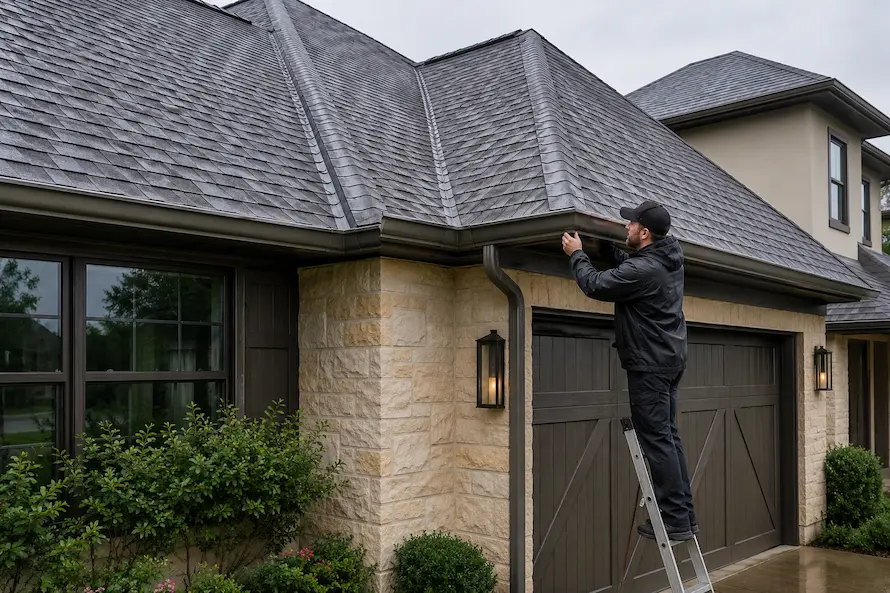
When homeowners compare 5 inch vs 6 inch gutters, the difference may seem minor. In practice, gutter size can affect how effectively a roof drainage system handles water, especially on homes with large roof surfaces, steep slopes, multiple valleys, or areas where water is concentrated into a limited number of downspouts.
For Houston homeowners, choosing the right gutter size should involve more than simply selecting the larger option. The appropriate system depends on the home’s roof design, drainage patterns, downspout configuration, and local conditions.
Both 5-inch and 6-inch gutters can work well when they are properly sized and installed for the property.
What Is the Difference Between 5-Inch and 6-Inch Gutters?
The most obvious difference is the width of the gutter channel.
A 5-inch gutter is a common residential size and can work effectively on many standard homes.
A 6-inch gutter provides a larger channel that can carry more water before reaching capacity.
That additional size may be useful when a roof sends a large amount of runoff toward specific sections of the gutter system.
However, gutter width is only one part of the drainage system.
Performance also depends on:
- Roof area
- Roof pitch
- Number of roof valleys
- Gutter slope
- Downspout size
- Number of downspouts
- Downspout placement
- Roof geometry
- Installation quality
- Debris accumulation
A larger gutter cannot fully compensate for poor drainage design or blocked downspouts.
Are 6-Inch Gutters Better Than 5-Inch Gutters?
Not automatically.
6 inch gutters can provide greater capacity, but that does not mean every home needs them.
A properly designed 5-inch gutter system may be sufficient for a smaller or simpler roof with well-positioned downspouts.
On the other hand, a larger or more complex home may benefit from the additional capacity of 6-inch gutters.
The better question is:
How much water does the roof send to each section of the gutter system, and how efficiently can that water move through the downspouts?
That requires looking at the roof as a complete drainage system.
When 5-Inch Gutters May Be Sufficient
Five-inch gutters are commonly used on residential properties and may be appropriate when the home has relatively straightforward drainage requirements.
They may make sense when:
- The roof area is moderate
- Roof sections are not unusually large
- The roof pitch is not extremely steep
- Valleys do not concentrate excessive runoff into one location
- Downspouts are properly sized and spaced
- The gutter system has adequate slope
- Water does not regularly overflow during rain
For many standard residential roofs, a properly installed 5-inch system can perform effectively.
The key is making sure the system is sized for the actual roof rather than selected only because it is commonly used.
When 6-Inch Gutters May Make More Sense
6 inch gutters Houston homeowners consider are often selected for properties where the roof creates greater drainage demands.
A larger gutter may be worth considering when:
- The home has a large roof surface
- The roof has a steep pitch
- Several roof planes drain toward the same area
- Multiple valleys concentrate water
- The home has experienced gutter overflow
- Downspout locations are limited
- Larger downspouts are being installed
- The roof design creates high-volume runoff points
The additional gutter capacity can provide more room for water to move before overflow occurs.
That said, increasing gutter size should still be part of a properly designed system.
Roof Size and Residential Gutter Sizing
Roof size is one of the most important factors in residential gutter sizing.
A larger roof surface collects more rainwater than a smaller one.
But contractors do not simply look at the total square footage of the entire roof.
The more important question is how much roof area drains into each gutter section.
For example, a large roof may distribute runoff among several gutter runs and downspouts.
Meanwhile, a smaller but complex roof may direct water from several planes into one valley and then into a short gutter section.
This is why visual roof design matters just as much as overall home size.
How Roof Pitch Affects Gutter Size
Roof pitch can influence how quickly runoff reaches the gutter.
A steeper roof can move water toward the eaves more rapidly than a low-slope roof.
This does not automatically mean that every steep roof needs 6-inch gutters, but pitch should be considered alongside other factors.
A steep roof combined with:
- Large roof planes
- Long gutter runs
- Limited downspouts
- Multiple valleys
may place greater demand on the gutter system.
A roofing contractor can evaluate these conditions during an inspection rather than relying on gutter size alone.
Why Roof Valleys Matter
Roof valleys are particularly important when evaluating gutter size for heavy rain.
A valley is where two roof sections meet and direct runoff toward the same general area.
During rainfall, valleys can concentrate a significant amount of water into a small section of gutter.
If that section does not have enough capacity—or if the nearest downspout cannot move water away quickly enough—overflow may occur.
Signs of concentrated drainage problems can include:
- Water spilling over the gutter near a valley
- Soil erosion below the roof edge
- Water marks on siding
- Saturated landscaping
- Repeated pooling near the foundation
In some situations, the solution may involve larger gutters.
In others, the more important improvement may be downspout size, placement, or overall drainage design.
Downspouts Are Just as Important as Gutter Size
Homeowners sometimes focus entirely on whether they should install 5-inch or 6-inch gutters.
But the gutter is only responsible for collecting and directing water.
The downspouts must then carry that water away.
If downspouts are undersized, poorly positioned, clogged, or too few in number, a larger gutter can still overflow.
A well-designed system should consider:
- Downspout dimensions
- Number of downspouts
- Distance between them
- Gutter run length
- Areas where valleys discharge
- Where the downspout releases water
A 6-inch gutter paired with appropriately designed downspouts may be useful for higher-volume roof sections.
But bigger is not automatically better if the rest of the system is not planned correctly.
5-Inch vs. 6-Inch Gutters for Houston Rain Conditions
Houston homeowners regularly deal with periods of significant rainfall, so roof drainage should be treated as an important part of home maintenance.
That does not mean every Houston property should automatically receive 6-inch gutters.
Instead, local weather conditions make it especially important to evaluate the entire drainage system.
The best gutters for Texas homes should be chosen based on:
- Roof architecture
- Roof surface area
- Pitch
- Valleys
- Existing drainage problems
- Downspout design
- Property drainage around the home
If the current system frequently overflows during rainfall even when it is clean, that may indicate a sizing or drainage-design issue worth evaluating.
Signs Your Gutters May Be Undersized
Overflow does not always mean the gutters are too small.
Clogs, improper slope, or damaged sections can produce similar symptoms.
However, possible signs of an undersized or poorly designed system include:
- Regular overflow despite clean gutters
- Heavy water discharge near roof valleys
- Water consistently overshooting the gutter
- Repeated soil erosion below certain roof sections
- Water staining on fascia or siding
- Drainage problems concentrated in the same areas
A professional evaluation can help determine whether the problem is gutter capacity or something else.
Can Larger Gutters Help Prevent Overflow?
Larger gutters may help in situations where the existing channel cannot handle the volume of runoff reaching it.
However, overflow can also occur because of:
- Clogged gutters
- Blocked downspouts
- Improper gutter slope
- Too few downspouts
- Poor downspout placement
- Loose or sagging gutters
- Incorrect installation
- Water concentrating from roof valleys
That means replacing 5-inch gutters with 6-inch gutters without identifying the actual cause may not solve the problem.
The entire roof drainage system should be inspected first.
Gutter Size and Storm Damage
Storm conditions can place additional stress on roof drainage systems.
Wind can also move leaves, branches, roofing debris, and other materials into gutters and downspouts, restricting water flow.
After significant weather events, homeowners may notice:
- Detached gutters
- Bent sections
- Loose fasteners
- Damaged downspouts
- Debris buildup
- New overflow areas
- Damage near roof edges
If gutter problems appear after a storm, the roof itself should also be evaluated for potential damage.
Cost Considerations: 5-Inch vs. 6-Inch Gutters
Six-inch gutters generally involve more material than 5-inch systems and may also be paired with larger downspouts.
That can make the overall project more expensive.
However, the cost difference should be evaluated in the context of the home’s drainage requirements.
Choosing smaller gutters only to reduce upfront cost may not be beneficial if the roof actually requires greater capacity.
Likewise, paying for larger gutters may be unnecessary if a properly configured 5-inch system can handle the roof effectively.
Other project factors may include:
- Total gutter length
- Number of stories
- Roof accessibility
- Number of corners
- Downspout quantity
- Removal of existing gutters
- Material selection
- Fascia condition
- Installation complexity
The appropriate gutter system should balance capacity, project conditions, and long-term function.
Do Larger Gutters Look Different?
Six-inch gutters are visibly larger than 5-inch gutters, although the difference often feels relatively subtle once they are installed on a home.
On larger homes, 6-inch gutters can sometimes appear proportionate to the roofline.
On smaller homes, homeowners may prefer the appearance of a smaller system when its capacity is sufficient.
Color and material selection can also help gutters blend with:
- Fascia
- Trim
- Siding
- Roofing materials
Function should remain the primary consideration, but appearance can still be part of the final selection.
Why Proper Installation Matters
Even the right gutter size can perform poorly if installation is incorrect.
A gutter system should be installed with an appropriate slope so water moves toward downspouts.
Other important installation details include:
- Secure fastening
- Correct downspout placement
- Proper outlet sizing
- Sealed joints
- Appropriate positioning along the roof edge
- Stable fascia attachment
Improperly positioned gutters may allow water to run behind the system or overshoot it.
A professional installation should consider both the gutter itself and how water moves off the roof.
Should You Upgrade From 5-Inch to 6-Inch Gutters?
An upgrade may make sense if the existing system consistently struggles with runoff and the underlying problem is confirmed to be inadequate drainage capacity.
Before replacing the gutters, evaluate:
- Are the existing gutters clean?
- Are the downspouts clear?
- Are the gutters properly sloped?
- Are they sagging or damaged?
- Does overflow happen mainly near valleys?
- Is the roof unusually large or steep?
- Are there enough downspouts?
- Could the problem come from installation rather than size?
Answering these questions can help determine whether a larger system is justified.
Frequently Asked Questions
They can provide greater water-carrying capacity than smaller gutters, which may be useful on roofs with high runoff volume. However, proper downspout sizing, placement, roof design, and installation remain essential.
They can be. Many residential homes use 5-inch gutters successfully. Whether they are sufficient depends on roof size, pitch, drainage patterns, valleys, and downspout configuration.
Larger gutter systems are often paired with larger-capacity downspouts, but the appropriate configuration should be determined based on the roof and drainage design.
Possible causes include inadequate capacity, improper slope, too few downspouts, concentrated runoff from valleys, installation problems, or damaged sections. An inspection can help identify the source.
No. Houston’s rain conditions make effective roof drainage important, but gutter size should still be selected based on the individual roof and property.
Which Gutter Size Is Right for Your Houston Home?
When comparing 5 inch vs 6 inch gutters, there is no single size that is automatically best for every Houston home.
Five-inch gutters may provide sufficient drainage for many standard residential roofs.
Six-inch gutters may make more sense on larger or steeper roofs, homes with complex roof geometry, areas with concentrated valley runoff, or properties where additional drainage capacity is needed.
The best approach is to evaluate the roof, gutter runs, valleys, downspouts, and existing drainage performance together.
Rhino-Vations Roofing can inspect your roof drainage system and help determine whether 5-inch gutters, 6-inch gutters, or another drainage improvement makes the most sense for your Houston-area home.