



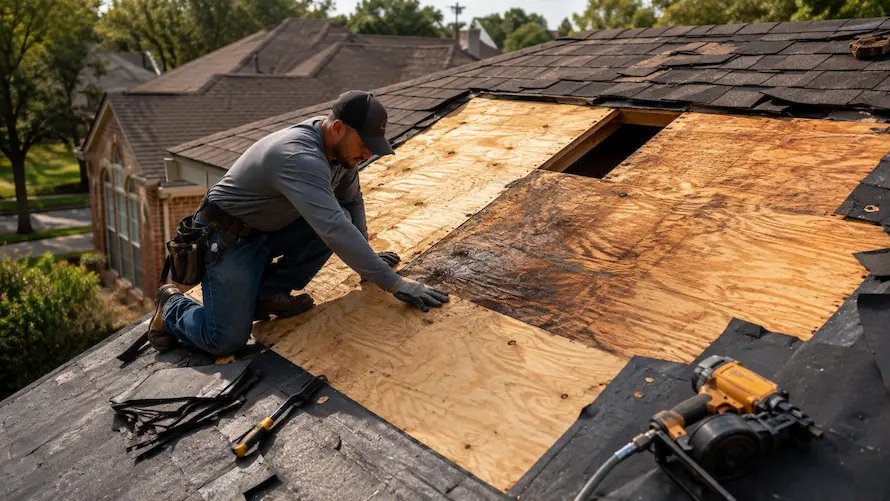
The roof decking replacement cost for a Houston home can vary significantly because damaged decking is rarely a simple one-size-fits-all repair.
The final cost depends on how much decking needs to be removed, whether the roof uses plywood or OSB, the thickness of the sheathing, labor requirements, roof pitch, access, moisture damage, and whether additional problems are discovered once the roofing materials are removed.
In many cases, homeowners do not know they have damaged roof decking until a roof repair or replacement is already underway.
That is why it is often more useful to understand the factors that affect cost rather than relying on a single price estimate before the roof has been inspected.
What Is Roof Decking?
Roof decking, also called roof sheathing, is the structural surface installed over the roof framing and beneath the roofing system.
On many residential homes, decking is made from:
- Plywood
- Oriented strand board, commonly called OSB
The decking provides a stable surface for roofing materials such as underlayment and asphalt shingles.
It also helps distribute loads across the roof framing.
If decking becomes weakened by moisture, rot, prolonged leaks, or other damage, simply installing new shingles over it may not provide a sound base for the roofing system.
Why Roof Decking Damage Matters
Damaged roof decking can affect more than the appearance of the roof.
When sheathing becomes soft, deteriorated, or structurally compromised, it may no longer hold roofing fasteners properly.
Potential consequences include:
- Soft or unstable roof areas
- Reduced fastener holding strength
- Continued moisture damage
- Sagging sections
- Problems during roof replacement
- Damage spreading into nearby materials
If compromised decking is discovered, the affected sections should be evaluated before new roofing materials are installed over them.
How Is Damaged Roof Decking Discovered?
Roof decking damage is sometimes visible during a roof inspection, but many problems remain hidden beneath shingles and underlayment.
It may be discovered:
- During roof replacement
- While repairing a roof leak
- After storm damage
- During inspection of the attic
- When soft areas are identified
- After roofing materials are removed
Common warning signs may include:
- Water stains in the attic
- Persistent roof leaks
- Visible wood deterioration
- Sagging roof areas
- Soft spots
- Mold or moisture staining
- Damaged areas around roof penetrations
However, the full extent of the problem may not be clear until the roofing layers above the decking are removed.
Why There Is No Single Roof Decking Replacement Price
A homeowner may ask for a flat roof decking repair cost, but two roofs with similar square footage can require very different amounts of work.
One home may need only a few damaged panels replaced near a leak.
Another may have widespread moisture damage across several roof sections.
The final scope of work depends on the actual condition beneath the roofing materials.
For that reason, estimates should account for the factors that directly affect labor and material requirements.
Factor 1: Amount of Damaged Decking
The size of the damaged area is one of the biggest factors affecting the roof decking replacement cost.
A small localized repair may involve replacing only a limited section of sheathing.
More extensive damage may require multiple sheets or a large portion of the roof deck.
Cost generally increases as more material must be:
- Exposed
- Removed
- Replaced
- Fastened
- Integrated with surrounding roofing
The location of the damage also matters.
A small damaged area in a difficult-to-reach roof section may require more labor than a similar area in an easily accessible location.
Factor 2: Plywood vs. OSB Roof Decking
Residential roof decking is commonly made from plywood or OSB.
Both materials can be used successfully when appropriate for the roofing system and project conditions.
Plywood
Plywood is manufactured from layers of wood veneer bonded together.
Its price can vary depending on:
- Thickness
- Grade
- Local material availability
- Market conditions
A plywood roof replacement cost should therefore be considered as part of the larger roofing project rather than as a fixed number.
OSB
OSB is manufactured from wood strands bonded into structural panels.
It is widely used in residential construction and may have different material costs than plywood.
The OSB roof decking cost can also change depending on thickness, supply, and local conditions.
Material price is only one part of the total replacement cost. Labor, removal, roofing access, and the extent of the damage can have an equally important effect.
Factor 3: Decking Thickness
Roof sheathing comes in different thicknesses.
The correct material should match the structural and roofing requirements of the home.
Thicker panels generally contain more material and may cost more than thinner ones.
A contractor should determine what type and thickness are appropriate rather than choosing replacement panels based solely on the lowest material price.
Factor 4: Roof Pitch
Roof pitch affects how easily workers can move across the roof.
A steeper roof can require:
- Additional safety measures
- More careful material handling
- Slower work
- Greater labor requirements
As a result, two homes requiring the same amount of decking replacement may have different labor costs if one roof is significantly steeper or more difficult to access.
Factor 5: Roof Accessibility
Access to the damaged section also affects project complexity.
Factors may include:
- Number of stories
- Landscaping
- Nearby structures
- Roof height
- Roof complexity
- Limited equipment access
- Tight property conditions
An easily accessible single-story roof may be simpler to work on than a multi-story roof with several slopes and limited ground access.
Factor 6: Labor Requirements
Roof decking replacement requires more than simply laying down a new sheet of wood.
Workers may need to:
- Remove shingles.
- Remove underlayment.
- Identify the damaged decking.
- Remove deteriorated panels.
- Inspect the surrounding area.
- Install replacement sheathing.
- Properly secure the new decking.
- Restore the roofing system above it.
The amount of labor depends on the condition and location of the damaged area.
Factor 7: Hidden Moisture Damage
Moisture is one of the most important variables in rotten roof decking repair.
A leak visible in one location does not always mean the damage is limited to that exact spot.
Water may travel along:
- Rafters
- Decking seams
- Underlayment
- Fasteners
- Roof penetrations
Once roofing materials are removed, the affected area may turn out to be larger than expected.
That is one reason contractors may not be able to determine the final decking replacement scope until the roof is opened.
Factor 8: Structural Conditions Beneath the Decking
Sometimes decking damage is only part of the problem.
If moisture has reached structural components below the sheathing, additional evaluation may be required.
Possible concerns can include:
- Damaged rafters
- Deteriorated framing
- Long-term moisture exposure
- Sagging areas
- Previous improper repairs
These conditions can increase project complexity beyond simple sheathing replacement.
Factor 9: Removing Existing Roofing Materials
Damaged decking typically cannot be fully accessed until the roofing materials above it are removed.
The amount of removal required depends on the project.
During a complete roof replacement, the shingles are already being removed, making it easier to inspect large areas of decking.
During a smaller repair, workers may need to remove only the roofing around the suspected damaged section.
The type and amount of roofing material that must be removed can affect labor and project cost.
Is Roof Decking Replacement Usually Included in a Roof Replacement?
Not necessarily.
A standard roof replacement and decking replacement are related, but they are not the same thing.
A roof replacement typically involves removing the existing roofing materials and installing a new roofing system.
Once the roof is stripped, the contractor can inspect the exposed decking.
If sections are damaged, replacement may be recommended before the new roof is installed.
The amount of damaged decking cannot always be determined before tear-off because some problems remain hidden.
Homeowners should ask how potential decking replacement is handled in their roofing estimate or contract.
Why Damaged Decking Should Not Simply Be Covered
Installing new roofing over severely deteriorated decking can create problems.
New shingles and underlayment require a suitable surface beneath them.
If the deck is soft or rotten:
- Roofing fasteners may not hold properly
- The surface may not remain stable
- Existing moisture problems may continue
- Damage may worsen underneath the new roof
Replacing only the roofing material without addressing compromised decking can leave an underlying problem unresolved.
Can Only the Damaged Decking Be Replaced?
In many cases, localized decking damage can be addressed by replacing the affected sections rather than replacing the entire roof deck.
The appropriate scope depends on:
- Extent of deterioration
- Location of the damage
- Condition of surrounding decking
- Roof structure
- Moisture exposure
A professional roof inspection can help determine whether the problem appears localized or more extensive.
Roof Decking Damage From Leaks
Roof leaks are a common reason decking deteriorates.
Potential sources can include:
- Damaged shingles
- Flashing problems
- Roof penetrations
- Plumbing vents
- Chimneys
- Valleys
- Storm damage
When water repeatedly reaches the sheathing, the wood may weaken over time.
Repairing the decking alone is not enough if the original leak source remains active.
The water entry point should also be identified and repaired.
Can Storm Damage Lead to Decking Replacement?
Storms can damage roofing materials and allow water to reach the deck.
The resulting damage may not always appear immediately inside the home.
After significant wind, hail, or other severe weather, homeowners may notice:
- Missing roofing materials
- Damaged roof components
- New leaks
- Water stains
- Moisture in the attic
A professional inspection can help identify whether the roofing system has been compromised and whether further investigation is needed.
How Houston Conditions Can Affect Roof Decking
Houston-area roofs are exposed to heat, humidity, rainfall, and severe weather conditions.
These conditions do not automatically mean that roof decking will fail, but they make proper roof maintenance and moisture control especially important.
Problems can develop when:
- Roof leaks remain unrepaired
- Flashing is damaged
- Storm damage exposes the roof system
- Moisture becomes trapped
- Previous repairs fail
The longer water reaches wood decking, the greater the possibility that the damaged area may expand.
How to Estimate Your Roof Decking Replacement Cost
Before assuming that the entire roof deck must be replaced, homeowners should start with an inspection.
A contractor may evaluate:
- Visible roof damage
- Attic conditions
- Leak locations
- Soft or suspicious areas
- Existing roofing system
- Roof access and pitch
If a complete roof replacement is being performed, a more detailed decking inspection can occur after the roofing materials are removed.
The final roof sheathing replacement cost can then reflect the actual amount of damaged material found.
Questions to Ask a Roofing Contractor
Before beginning a roof repair or replacement that may involve decking, consider asking:
- How is damaged decking identified?
- How will additional decking replacement be documented?
- What decking material is used?
- What thickness will be installed?
- How is replacement decking priced?
- What happens if additional damage is discovered?
- Will the source of moisture also be repaired?
- Can damaged areas be photographed during the project?
Clear communication can help homeowners understand why additional work may become necessary.
Frequently Asked Questions
There is no single price that applies to every home. Cost depends on the amount of damaged decking, plywood or OSB selection, thickness, labor, roof pitch, access, hidden moisture damage, and the roofing materials that must be removed.
Material pricing can vary over time and by thickness, grade, and local availability. Plywood and OSB may have different costs, but the total project price also depends heavily on labor and the extent of replacement.
Possible signs include soft roof areas, sagging, leaks, attic moisture, staining, or visible wood deterioration. Some damage remains hidden until shingles and underlayment are removed.
Severely compromised or rotten decking should generally be addressed before new roofing is installed because the roofing system needs a stable fastening surface.
Yes. This is common because removing the existing roofing materials exposes the decking and allows contractors to inspect areas that were previously hidden.
Get the Roof Decking Evaluated Before Covering the Problem
The roof decking replacement cost in Houston depends on the actual condition of the roof rather than a single standard price.
The size of the damaged area, plywood or OSB selection, sheathing thickness, labor, roof pitch, accessibility, moisture, hidden damage, and structural conditions can all influence the final scope of work.
Most importantly, damaged decking should be evaluated before it is covered by a new roofing system.
If you suspect rotten or damaged roof decking, Rhino-Vations Roofing can inspect the roof, identify visible concerns, and recommend the appropriate next steps for repair or replacement based on the conditions found.
Leave a Reply